Kuwait's leading supplier of electrical contactors for HVAC and air conditioning systems. 2-pole and 3-pole contactors in all ampere ratings — genuine parts, expert advice, and fast delivery across all of Kuwait.
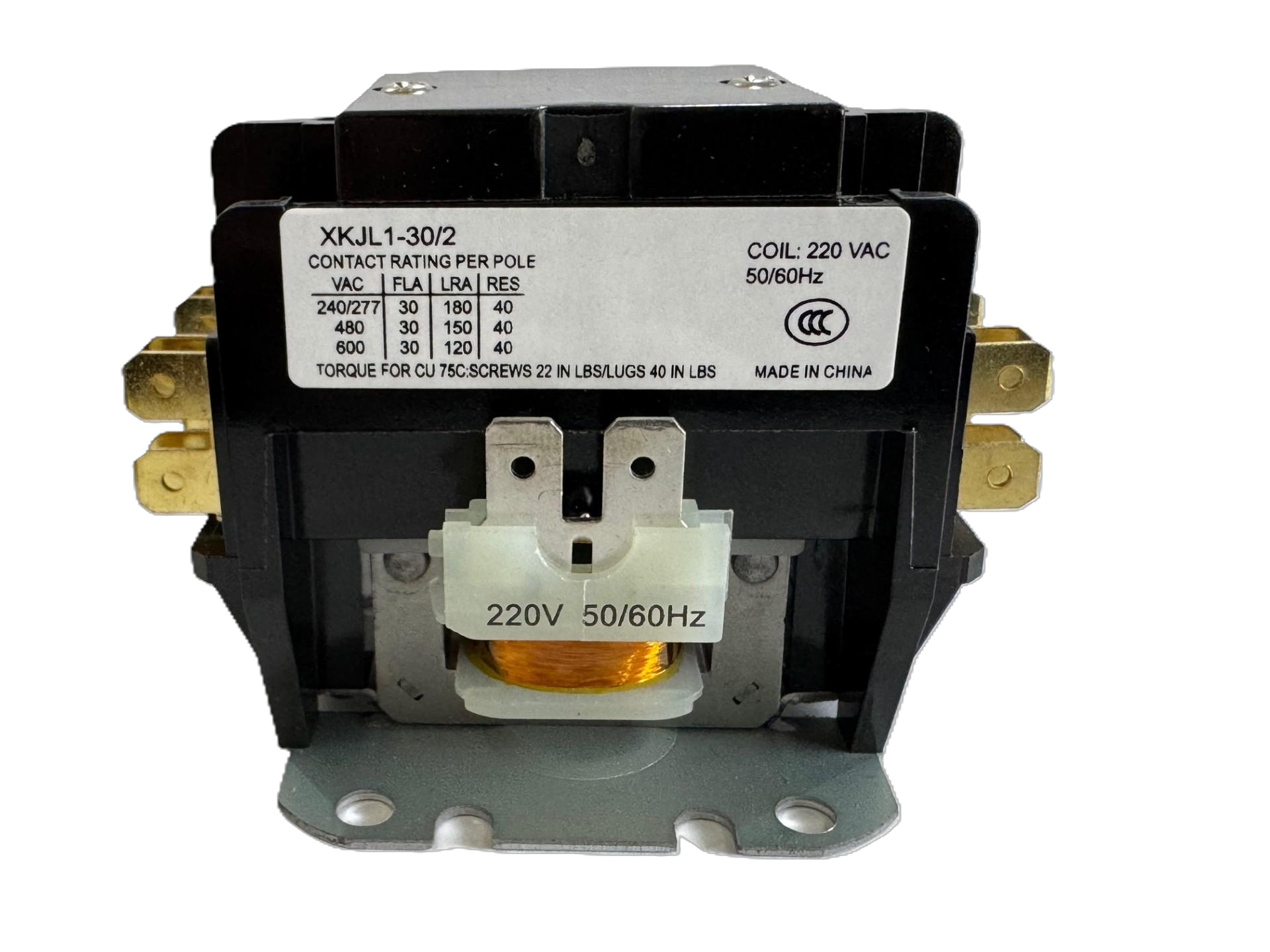
An electrical contactor is a heavy-duty, electrically controlled switch designed to open and close high-current power circuits. In HVAC and air conditioning systems across Kuwait, contactors are the core component responsible for switching the compressor, condenser fan motor, and other high-draw loads on and off. When your thermostat or control board sends a low-voltage signal to the contactor coil, it generates an electromagnetic pull that closes the main power contacts — delivering full line voltage to your compressor or motor. Unlike a standard relay, a contactor is built to handle the high inrush current of HVAC motors and is rated for tens of thousands of switching cycles.
Kuwait's extreme summer heat means AC systems run almost continuously from May through September, putting contactors under constant stress. Repeated high-inrush compressor starts cause the silver alloy contacts to pit, burn, or in the worst case weld together. A failing contactor is one of the most frequent causes of AC breakdown in Kuwait during peak summer. Common signs include the outdoor unit failing to start, a buzzing or chattering noise from the contactor, visible burn marks on the contacts, or the unit running continuously without shutting off. Replacing a worn contactor quickly is critical — a failed contactor left in service can destroy a far more expensive compressor.
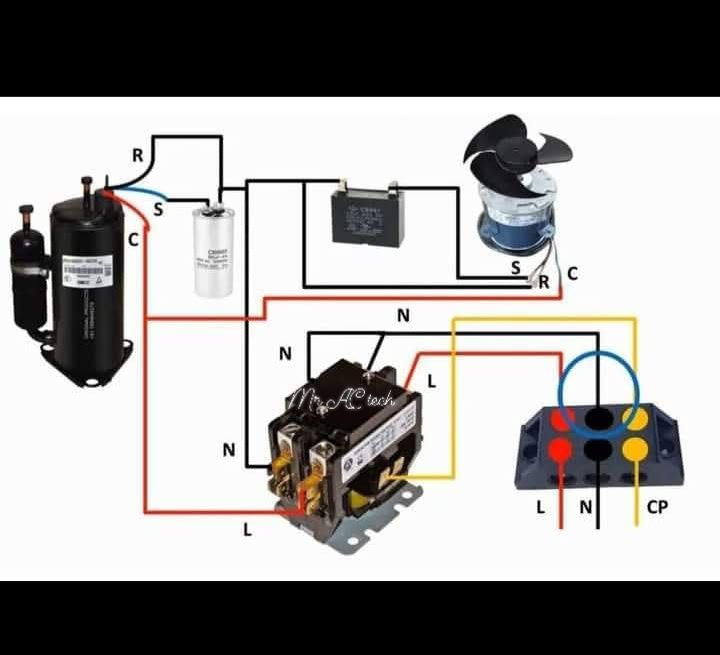
We carry 2-pole and 3-pole contactors to cover every HVAC application in Kuwait — from compact residential split units to large commercial central air systems. All contactors are genuine, fully rated parts available in multiple ampere ratings.
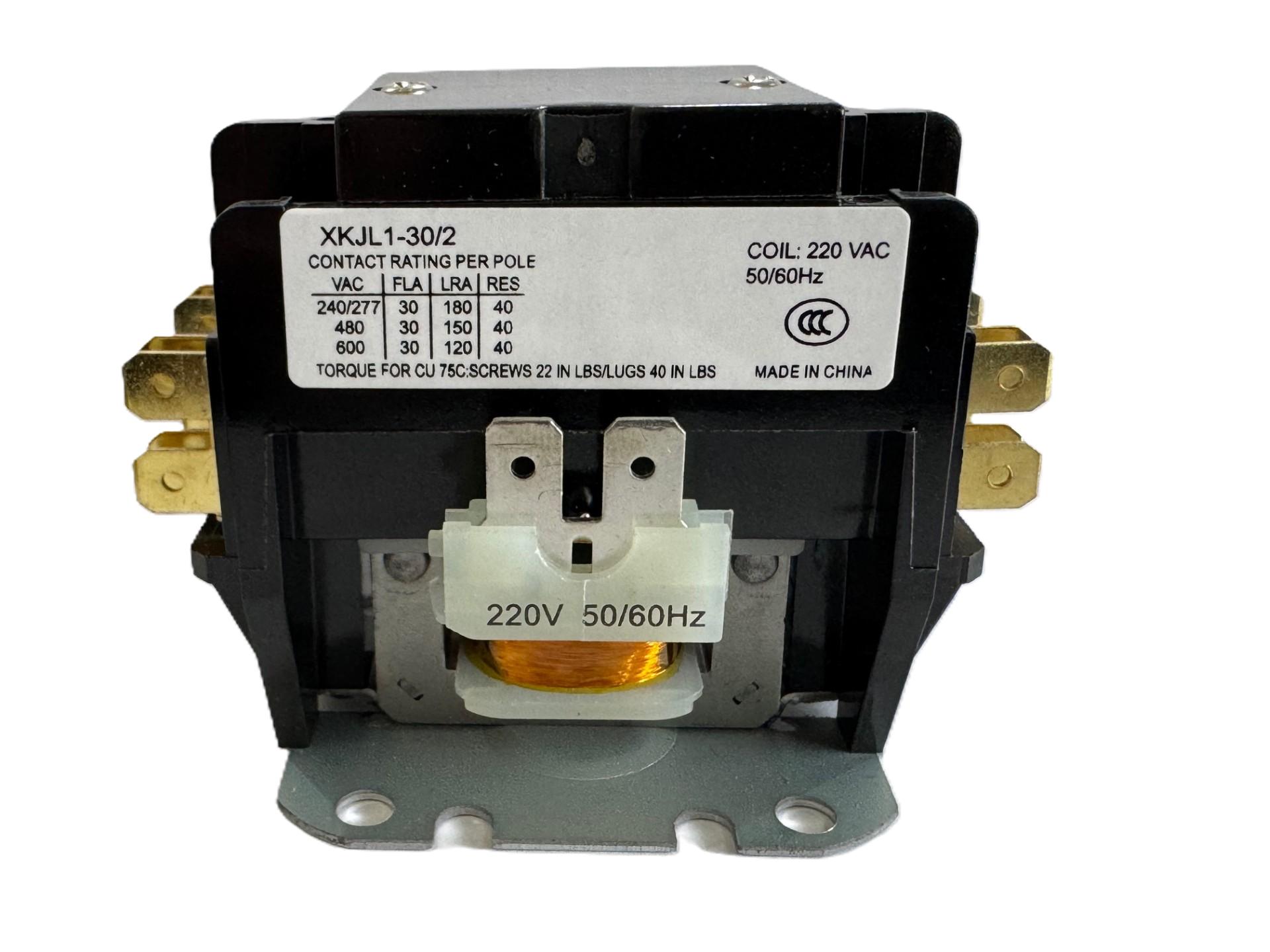
The most widely used contactor in Kuwait's residential HVAC market. 2-pole contactors control the single-phase compressor circuit in split AC units, window ACs, and smaller package units. Available in ratings from 25A to 50A with 24V, 110V, or 220V coil options — compatible with virtually all residential AC brands installed across Kuwait.
Browse 2-Pole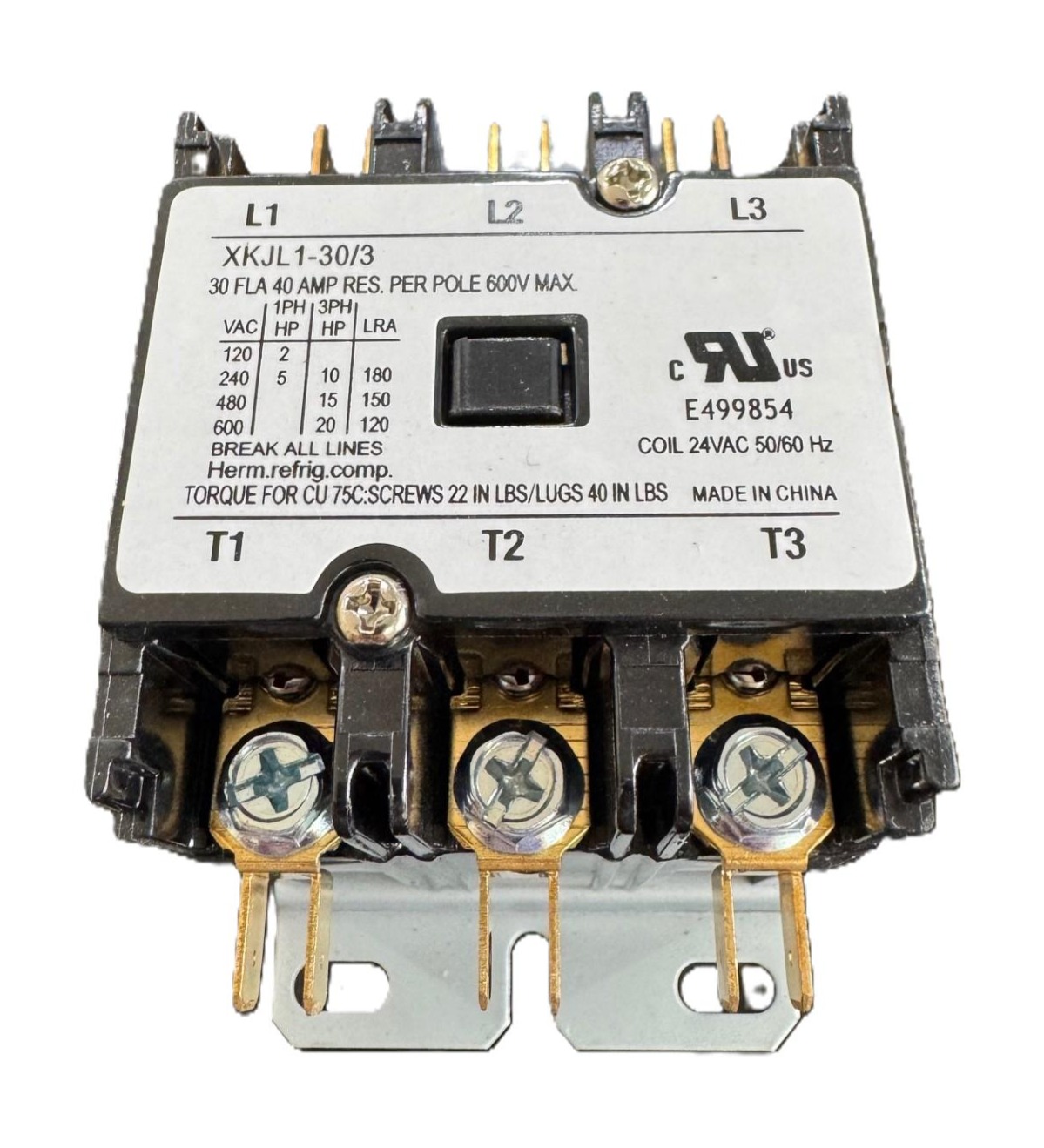
Designed for three-phase HVAC equipment including commercial package units, central air systems, chillers, and rooftop units. 3-pole contactors are essential for any commercial or industrial AC installation in Kuwait operating on a 380V three-phase supply. Available from 9A to 100A to handle any load.
Browse 3-PoleSelecting the correct contactor for your AC system in Kuwait comes down to four key criteria. First, the number of poles — 2-pole for single-phase systems (standard residential split ACs) or 3-pole for three-phase commercial systems. Second, the current (ampere) rating — always choose a contactor rated at or above the full-load current on your compressor or motor nameplate; an under-rated contactor will overheat and fail prematurely. Third, the coil voltage — this must match your control circuit: 24V AC is standard on most modern thermostats and inverter ACs, while older or commercial systems may use 110V or 220V coils. Fourth, the duty rating — for HVAC compressor switching, the contactor must be rated AC3 (inductive motor loads), not AC1 (resistive loads only).
Contactors carry IEC ratings that are essential to understand when sourcing replacements in Kuwait. The utilization category (AC1 vs AC3) indicates the type of load — AC3 is the correct rating for motor switching in HVAC equipment as it accounts for the high inrush current during compressor start. The rated insulation voltage (Ui) must exceed your supply voltage. The rated impulse voltage (Uimp) indicates surge withstand capability — important given Kuwait's electrical infrastructure. Standard Kuwaiti electrical supply is 240V single-phase and 415V three-phase at 50Hz; always verify your replacement contactor is rated for these values.
We stock contactors from the most trusted brands in HVAC and industrial electrical applications. Schneider Electric (LC1-D series) is the most widely used in Kuwaiti residential and light commercial AC installations. Siemens (3RT series) and ABB are preferred for commercial and industrial projects. LS Electric and Chint offer reliable, cost-effective alternatives suited for high-volume service work. Togami contactors are a proven choice for compressor control in split and package units throughout Kuwait.
Kuwait's combination of intense summer heat, coastal humidity, and dust accelerates contactor wear significantly. Annual contact inspection is strongly recommended for any AC system running through the Kuwaiti summer. Check for contact pitting caused by arc erosion, carbon buildup between contacts, and weakened mechanical spring tension. Measure coil resistance with a multimeter to confirm the coil has not degraded. Ensure all terminal screws are correctly torqued — vibration from outdoor units loosens connections over time. Clean contact surfaces with an approved electrical contact spray. Replace the contactor immediately if contact wear has reduced the gap below manufacturer specification; never file or sand contacts as this removes the protective silver alloy layer.
During Kuwait's peak summer months from May through September, AC contactors operate almost continuously under extreme heat — making them one of the most frequently replaced HVAC components in the country. Recognizing the signs of a failing contactor early can prevent a costly compressor replacement.
Replacing an AC contactor is one of the most straightforward HVAC repairs, typically completed by a qualified technician in under 15 minutes. Always isolate and lock out power at the circuit breaker before starting — never work on a live contactor. Photograph the existing wiring before disconnecting anything to ensure correct reconnection. Verify the replacement matches the original in poles, ampere rating, and coil voltage. Use correctly sized wire lugs on all terminals and torque to specification. After installation, test continuity through the main contacts with a multimeter before restoring power. Finally, confirm the contactor closes cleanly when the coil is energized before handing the unit back to service.
A contactor is a heavy-duty electromagnetic device — and a contactor is not the same as a standard relay or circuit breaker. A relay is typically used for lower-current signal switching, while a contactor is designed for the high-current, high-inrush demands of HVAC motors and compressors. The contactor coil is the electromagnetic component that, when energized, creates the magnetic force to close the main contacts and deliver full line voltage to the load.
Contacts are the most wear-prone part in any contactor. The contacts are made of silver alloy to ensure reliable, low-resistance conduction through thousands of switching cycles. Contact pitting — small craters burned into the contact surface by electrical arcing — is the leading cause of contactor failure in Kuwait's heavy-use summer environment. Recognizing worn contacts and replacing them before failure prevents costly compressor damage.
Main contacts and auxiliary contact serve different roles within the contactor assembly. The main contacts switch the high-power load circuit — the compressor or motor — while the auxiliary contact handles lower-current signaling and interlocking in the control circuit. Understanding both contacts and how they interact is essential for diagnosing faults and designing correct control circuits in commercial HVAC installations across Kuwait.
Contactors are used for high voltage switching in HVAC compressor control, three-phase fan motor circuits, chiller starters, and commercial rooftop unit control. The contactor is not a fuse or circuit breaker — it is a load switching device. Contactors are built to switch electrical loads safely across thousands of on/off cycles under Kuwait's extreme operating conditions, making them the most critical electrical component in any HVAC system.
The coil is the electromagnetic heart of every contactor. The rated coil voltage (24V, 110V, or 220V) must exactly match the output of your control circuit. Failure modes of a contactor can be identified through visual inspection and electrical testing: a burned-out coil shows an open circuit on a multimeter, while welded contacts indicate repeated overcurrent switching. The contactor is not repairable once the coil or contacts have failed — proactive replacement is the safest approach for HVAC systems operating through Kuwait's intense summer months.
The primary function of the contactor is to open and close a power circuit safely. The coil to the contactor must be energized with the correct voltage for operation to occur — without a coil signal, the contacts remain open and the power circuit stays broken. When power is applied to the coil, it generates a magnetic field and causes the contacts to close. The coil to the contactor coil assembly is what makes the contactor fundamentally different from a manual switch: it allows a low-voltage control signal to switch a high-voltage power circuit remotely and automatically.
Understanding the power circuit versus the control circuit is essential. The power circuit carries the full load current to the motor or compressor, while the control circuit carries only the low-voltage coil signal. The power circuit must be rated for the full-load and inrush current of the connected load. A magnetic contactor rated below the power circuit requirements will overheat, arc excessively, and fail prematurely. Always select a contactor where the power circuit rating meets or exceeds the demands of the motor.
To control a circuit remotely is the defining purpose of a contactor. When a thermostat sends a signal to the contactor, the coil to the contactor energizes, which is what creates a magnetic field and causes the contacts to close. This allows the power to flow to the motor. Used to switch a circuit carrying hundreds of amps, the contactor operates as a relay scaled up for industrial and commercial load levels. Relays are used in the same way but from a signal perspective only — relays are not rated for the current demands of a compressor or three-phase motor, which is why contactors are the correct choice in all HVAC power switching applications.
From a circuit design standpoint, a circuit breaker protects from a fault condition, while the contactor controls the routine on/off switching of the load. To control a circuit effectively, both must be present: the breaker as the short-circuit protection device and the contactor as the switching device. Without a contactor in the circuit, the only way to switch the motor would be manually — which is not practical for automated thermostat-controlled HVAC systems.
Relays are electromagnetic switching devices that operate on the same basic principle as a contactor. However, relays are designed for low-current signal circuits, while contactors are required when switching the motor currents found in HVAC equipment. Relays are commonly used in the control circuit alongside a contactor — the relay carries the thermostat signal and the contactor switches the motor. Relays are not suitable as a direct replacement for a contactor in the power circuit of a compressor or fan motor. Relays are built to lighter mechanical and electrical tolerances than contactors, and relays are not rated for AC3 inductive motor switching duty.
The motor is the largest electrical load in any HVAC system, and the contactor exists primarily to switch the motor on and off safely. The motor draws a high inrush current — typically five to seven times its full-load running current — every time it starts. The contactor must be rated to handle this inrush without welding its contacts. The motor nameplate lists the full-load current, which is the minimum ampere rating your replacement contactor must meet. In Kuwait's summer, the motor starts and stops frequently as the thermostat cycles — placing the contacts of the contactor under repeated high-stress switching loads. Ensuring the motor's contactor is correctly sized and in good condition is the single most effective preventive maintenance step an HVAC technician can take.
As the load amperage increases, the thermal and mechanical demands on the contactor increase proportionally. In a split AC unit, the load such as the compressor may draw 15–25A; in a commercial package unit, the load such as a three-phase compressor may draw 40–80A. Contactors such as the Schneider LC1-D series are available in a full range of ratings to match any load such as these. Always select a contactor with a minimum 10–20% margin above the full-load current of the connected equipment — as the load can vary with supply voltage and ambient temperature. In Kuwait, where ambient temperatures regularly exceed 45°C in summer, the contactor operates in a thermally stressed environment; choosing a contactor rated above the minimum protects against derating effects caused by heat.
As the contacts wear over time, the resistance across them increases, which generates additional heat in the circuit. As the contact gap reduces due to erosion, the contactor becomes less reliable at interrupting the circuit cleanly. As the spring tension weakens, the contacts may not close fully, causing arcing during operation. All of these mechanisms accelerate as the temperature rises — which is why Kuwait HVAC technicians replace contactors proactively each summer rather than waiting for failure.
There is a critical requirement that the coil voltage must match the control circuit output exactly. If there is a mismatch — for example, fitting a 220V coil to a 24V control circuit — the coil will not energize and the contactor will not close. If there is the reverse mismatch, the coil will burn out instantly. There is no tolerance for error in coil voltage selection. There is also a consideration for coil voltage stability: in Kuwait, supply voltage fluctuations can cause a 24V transformer output to vary; if there is a significant voltage drop in the control circuit wiring, the coil may chatter or fail to hold closed, causing the buzzing noise reported by technicians during summer service calls.
Voltage and current are the two defining parameters when selecting a contactor. The voltage and frequency of the supply must be within the contactor's rated insulation voltage and utilization category. In Kuwait, standard single-phase supply is 240V at 50Hz and three-phase supply is 415V at 50Hz — voltage and tolerance of ±10% must both be within the contactor's rated range. The current rating must exceed the full-load amperage of the connected motor, with voltage and temperature derating applied for Kuwait's extreme ambient conditions. Confirming both voltage and current ratings against nameplate data before purchasing a replacement contactor eliminates the most common sourcing errors.
Which is the correct replacement when the original brand is unavailable? In Kuwait's HVAC market, direct cross-references exist between all major brands. Which is equivalent to a Schneider LC1-D25 can be found in the Siemens 3RT, ABB A-series, LS GMC, and Chint NC1 ranges — all of which share the same pole configuration, ampere rating, and coil voltage options. Which is the better choice between brands depends on the application: Schneider and Siemens are preferred for precision commercial work, while Chint and LS offer the same electrical performance at a lower price point for high-volume residential service. Our team can advise on which is the correct cross-reference for any contactor currently in your system.
Without a correctly rated contactor, even a brand-new compressor can fail prematurely. Without a contactor at all, there is no automated way to switch the compressor circuit on and off — making it the non-negotiable electrical component in any HVAC installation. Without a proper AC3 utilization rating, a contactor will arc excessively at every motor start and its contacts will fail in a fraction of the expected service life. Without a matching coil voltage, the contactor simply will not operate. Without a contactor rated for Kuwait's ambient temperatures and heavy summer duty, expect annual or more frequent failures. This is why our technical team verifies every specification before shipping — so that without exception, the part you receive is the correct one for your application.
In a magnetic contactor, the operation is driven entirely by electromagnetic force. When the coil is energized, it creates a magnetic field in the iron core of the contactor. In a magnetic circuit, the armature — the movable iron plate — is attracted to the core, which causes the contacts attached to it to close. In a properly functioning contactor, this happens in milliseconds and produces a characteristic audible click. In a failing contactor, the magnetic force may be insufficient to fully close the contacts — caused by a weak coil or a worn armature — resulting in the chattering or buzzing sound that signals the need for immediate replacement.
A magnetic contactor is rated for its electromagnetic performance as well as its electrical ratings. A magnetic field of sufficient strength must be generated by the coil to hold the contacts closed against the spring force and the vibration of the outdoor unit. In Kuwait's heat, the coil resistance increases with temperature; if the coil resistance rises too far, the magnetic field weakens and the contacts may open intermittently — causing the compressor to cycle erratically. This thermal effect on the coil is one of the key reasons why genuine, full-specification contactors from brands such as Schneider and Siemens outperform low-cost alternatives in Kuwait's summer conditions.
As an electrically operated device, the contactor provides a critical safety function: it allows the power to the compressor to be interrupted instantly when the thermostat, safety cutout, or overload relay opens the control circuit. Used as an isolation mechanism in addition to switching, the contactor ensures that the motor is de-energized whenever the system is not calling for cooling. Used as an interface between the 24V control system and the 240V or 415V power circuit, the contactor separates low-voltage wiring from high-voltage wiring. Used in combination with an overload relay, the contactor and overload form a motor starter — the standard protection combination for three-phase HVAC equipment across Kuwait's commercial installations.
When a contactor fails, the symptoms depend on which component has failed. When a coil fails open, the compressor will not start at all — the thermostat calls, but the contacts never close. When a coil fails shorted, the contactor may draw excessive current and trip a fuse in the control circuit. When contacts weld shut, the compressor runs continuously regardless of the thermostat signal — a dangerous condition that can destroy the compressor from over-heating and lack of refrigerant cycling. When contacts pit excessively, the contactor may operate intermittently — starting and stopping erratically. When a contactor is undersized for the load, all of these failure modes accelerate significantly, which is why correct sizing is the most important factor in contactor selection for Kuwait's demanding HVAC environment.
The main purpose of the contactor is switching: a low-voltage signal sent to the coil of the contactor energizes the coil to generate a magnetic force. This force causes the contacts to close, which connects the power supply to the load. The operation of the contactor can be summarized as follows: the coil to load switching sequence begins when the control signal arrives, and the action causes the contacts to move from the open to the closed position. Understanding how the coil of the contactor interacts with the main contacts is essential for correct fault diagnosis. The action that causes the contacts to close is purely electromagnetic — there are no mechanical interlocks required. When the coil of the contactor de-energizes, the spring force causes the contacts to open again, breaking the load circuit.
Contactors — they are the switching devices used to control motor loads in HVAC systems. They are selected as part of the motor starter assembly, and they are installed as part of the main distribution panel or outdoor unit electrical compartment. They are available from us in all standard ratings, and they are sourced exclusively from authorized distributors. With the correct ampere rating, they are reliable for many thousands of switching cycles. With the correct coil voltage, they are guaranteed to operate every time the thermostat calls. With the correct utilization category (AC3), they are rated for the inductive inrush current of compressor and fan motor starts. Part of the selection process involves confirming that with the replacement contactor, all three parameters — poles, amps, and coil voltage — match the original. Part of our service is providing that technical verification for every order.
Used to control the compressor is the primary function of the contactor; used to control the fan motor is its secondary role. Used to protect the motor from unsafe switching conditions, the contactor works alongside an overload relay as part of a complete motor starter. Part of every HVAC service visit in Kuwait should include a visual inspection of the contactor — part of proactive maintenance that prevents expensive failures. They are one of the lowest-cost parts in an HVAC system, yet they are responsible for protecting one of the most expensive components: the compressor. They are worth replacing proactively — and they are available from HVACKWT with same-day dispatch.
The role of a contactor is to switch high-current loads such as compressors and fan motors on and off under full-load conditions. Applications such as split AC units, package units, chillers, and rooftop systems all rely on contactors for safe load switching. Equipment such as scroll compressors and three-phase induction motors produces high inrush currents at startup — which is exactly the condition that the AC3 duty rating is designed to handle. Brands such as Schneider Electric, Siemens, ABB, and Togami all produce contactors engineered for loads such as these. Systems such as those found in Kuwait's commercial buildings operate their contactors almost continuously through the summer, placing extraordinary demands on components such as the coil, the contacts, and the arc chambers. A technician's primary goal when selecting a replacement is to match loads such as the nameplate current and voltage exactly to the new contactor's ratings.
The function of the contactor is to switch — and its function is to do so reliably. Is to provide safe, automated load switching is the core design purpose, and is to do so for tens of thousands of cycles without maintenance is the design goal. The contactor is to be selected with a margin above the minimum rating; is to be installed with correctly torqued terminals; and is to be inspected annually in Kuwait's climate. The purpose is to protect the motor; the method is to interrupt the power circuit cleanly on every cycle; and the result is to extend the life of the compressor and the HVAC system as a whole.
In any HVAC control circuit, the thermostat signal is routed to a contactor as the final switching element. The 24V output of the control transformer is connected to a contactor coil, and the result causes the motor to start. An overload relay is often wired in series with the coil, providing protection to a contactor and its associated motor against sustained overcurrent. When an overload trips, it removes the signal to a contactor, which causes the contacts to open and the motor to stop safely. Connecting an auxiliary contact to a contactor allows status feedback — such as a "running" indicator or a BMS monitoring point. The auxiliary contact is wired in addition to a contactor's main poles, providing a separate low-current switching point in the control circuit without affecting the main power switching function. To a system integrator or building automation designer, the ability to add to a contactor's auxiliary contacts makes it a flexible component in larger HVAC control architectures.
Kuwait's most trusted HVAC parts supplier with decades of experience serving contractors, technicians, and businesses.
Every contactor we sell is sourced directly from authorized distributors of Schneider Electric, Siemens, ABB, LS Electric, Chint, and Togami. No counterfeits, no substandard substitutes — protecting your customers' equipment and your reputation as a technician.
Free delivery on all orders over 50 KWD, covering every governorate in Kuwait including Hawally, Ahmadi, Farwaniya, Jahra, and the Capital. In-stock contactors are dispatched same day or next business day — ideal for urgent service calls.
Our team has decades of combined experience supplying HVAC parts across Kuwait. Not sure which contactor fits your system? Call us, WhatsApp us, or visit our branches in Hawally or Ahmadi — we'll match the correct part by ampere rating, poles, and coil voltage.
Pay securely online via KNET, Visa, or Mastercard. Registered HVAC businesses and contractors can apply for a wholesale trade account for priority pricing and invoicing on contactors and all other HVAC parts.
Common questions from HVAC technicians and customers in Kuwait about buying and installing electrical contactors.
We stock 2-pole and 3-pole AC contactors in ampere ratings from 9A to 100A, with coil voltages of 24V, 110V, and 220V. Our range covers residential split AC units, commercial package units, and three-phase industrial HVAC systems. Brands available include Schneider Electric, Siemens, ABB, LS Electric, Chint, and Togami.
Match the replacement contactor to the original by: (1) number of poles — 2-pole for single-phase systems, 3-pole for three-phase; (2) ampere rating — check the full-load amps on the compressor or motor nameplate; (3) coil voltage — check your thermostat or control board output (usually 24V for modern systems). If you have the part number from the old contactor, contact us and we'll find an exact or direct replacement.
Yes, we deliver to all areas in Kuwait including Hawally, Salmiya, Jahra, Ahmadi, Farwaniya, and the Capital. Orders over 50 KWD qualify for free delivery. You can also pick up directly from our branches in Hawally and Ahmadi.
We carry contactors from Schneider Electric (LC1-D series), Siemens (3RT series), ABB, LS Electric, Chint, and Togami. All products are genuine and sourced from authorized distributors — no cheap imitations that could damage your HVAC system.
Yes, we offer wholesale pricing for HVAC contractors and businesses across Kuwait. Submit a wholesale quote request through our website or contact us directly for volume pricing on contactors and all other electrical HVAC parts. Trade accounts are available for registered businesses.
In-stock contactors are dispatched same day or the next business day. Delivery within Kuwait typically takes 1–2 business days. For urgent service call requirements, contact us directly and we'll do our best to prioritize your order.
Browse our full catalog of contactors in all ampere ratings, add to cart, and get them delivered to your door in Kuwait.